
Table of Contents
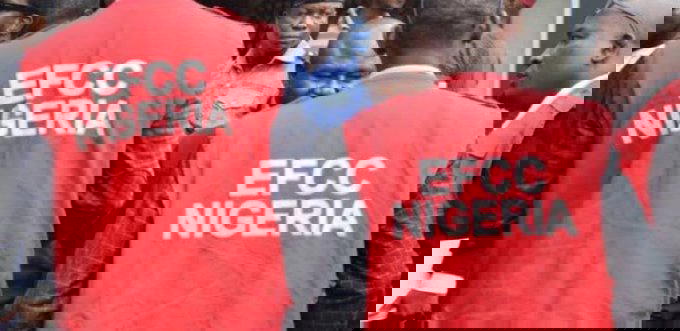
Nigeria’s anti-graft agency, the Economic and Financial Crimes Commission (EFCC), has exposed deep lapses within the country’s financial ecosystem, revealing how banks, fintech firms, and microfinance institutions enabled the movement of ₦162 billion in cryptocurrency transactions and ₦18.7 billion in fraud proceeds without proper customer checks.
The EFCC said the regulatory failures allowed large-scale scams to thrive, affecting over 900,000 Nigerians, as criminals many of them foreign nationals exploited weak Know Your Customer (KYC) and Customer Due Diligence (CDD) controls to launder illicit funds through Nigeria’s financial system.
EFCC Unveils Findings in Abuja
The revelations were made on Thursday in Abuja during a media briefing by Wilson Uwujaren, Director of Public Affairs and Commander of the EFCC, as the Commission outlined major breakthroughs recorded at the start of its 2026 operational year.
Uwujaren disclosed that fraud proceeds were often converted into digital assets and transferred offshore, with financial institutions failing to flag or halt suspicious and structured transactions.
Fake Airline Ticket Scheme Exposed
According to the EFCC, one of the uncovered schemes involved a syndicate that used a fake airline ticket discount platform to defraud unsuspecting foreign travellers.
Uwujaren explained that the payment systems were deliberately designed to look like official airline accounts, convincing victims that their payments were legitimate.
“Once payment is made, the victim’s entire bank balance is wiped out,” he said.
Although only seven victims initially reported the scam, EFCC investigations later uncovered over 700 victims, with total losses estimated at ₦651,097,755. The Commission said it has so far recovered and returned ₦33,628,000 to affected victims.
Investigators traced the operation to a foreign national, who allegedly recruited young Nigerians, supplied them with laptops and specialised software, and used compromised accounts to carry out the fraud. Proceeds were converted into cryptocurrency and moved through the Bybit exchange.
₦18bn Investment Scam Hits 200,000 Nigerians
The EFCC also uncovered a far-reaching investment scam linked to Fred and Farid Investment Limited (FF Investment), which promised fake investment returns to Nigerians.
Uwujaren said more than 200,000 victims were defrauded, with about ₦18.09 billion generated through nine affiliated companies posing as legitimate investment platforms.
The companies named include:
- Credio Banco Limited
- Deliberty Rock Limited
- Liam Chumeks Global Service
- Ngwuoke Daniels Technology
- Icons Autos and Import Merchant
- Newpace Technology Services Limited
- Primepath Ways Ventures Limited
- Kaka Synergy Network Limited
- Sunlight Tech Hub Services Limited
Once again, the EFCC said investigations pointed to foreign masterminds, with three Nigerian collaborators already arrested and charged to court. Efforts are ongoing to apprehend suspects who fled the country.
Banks, Fintechs Under Scrutiny
A major concern raised by the Commission was the role of financial institutions in enabling the fraud.
Uwujaren disclosed that a new-generation bank, alongside six fintech and microfinance banks, bypassed standard compliance procedures, allowing ₦18.74 billion in scam proceeds to pass through the system unchecked.
More troubling, he said, was the discovery that ₦162 billion in cryptocurrency transactions flowed through a single new-generation bank without adequate due diligence. In another case, a bank reportedly allowed one customer to operate 960 accounts, all allegedly used for fraudulent activities.
“It is worrisome that such volumes of transactions could pass through our system without any meaningful scrutiny,” Uwujaren said.
EFCC Warns of Sanctions
The EFCC called on financial regulators to enforce stricter compliance across the sector, warning that institutions found to be aiding or abetting fraud would face severe consequences.
“Deposit money banks, fintechs, and microfinance banks found to be complicit should be suspended and referred to the EFCC for thorough investigation and possible prosecution,” Uwujaren warned.
He stressed that negligence, weak monitoring systems, and failure to report suspicious transactions would no longer be tolerated.
Commitment to Protect Financial System
Uwujaren reaffirmed the Commission’s resolve to clamp down on money laundering, cybercrime, and financial fraud, noting that safeguarding Nigeria’s financial system is essential to maintaining public trust and economic stability.
The EFCC said it would continue working with regulators and stakeholders to close loopholes that allow criminal networks to exploit the country’s banking and digital finance infrastructure.
Get real time update about this post category directly on your device, subscribe now.
Discover more from The Trenet
Subscribe to get the latest posts sent to your email.

