
Table of Contents
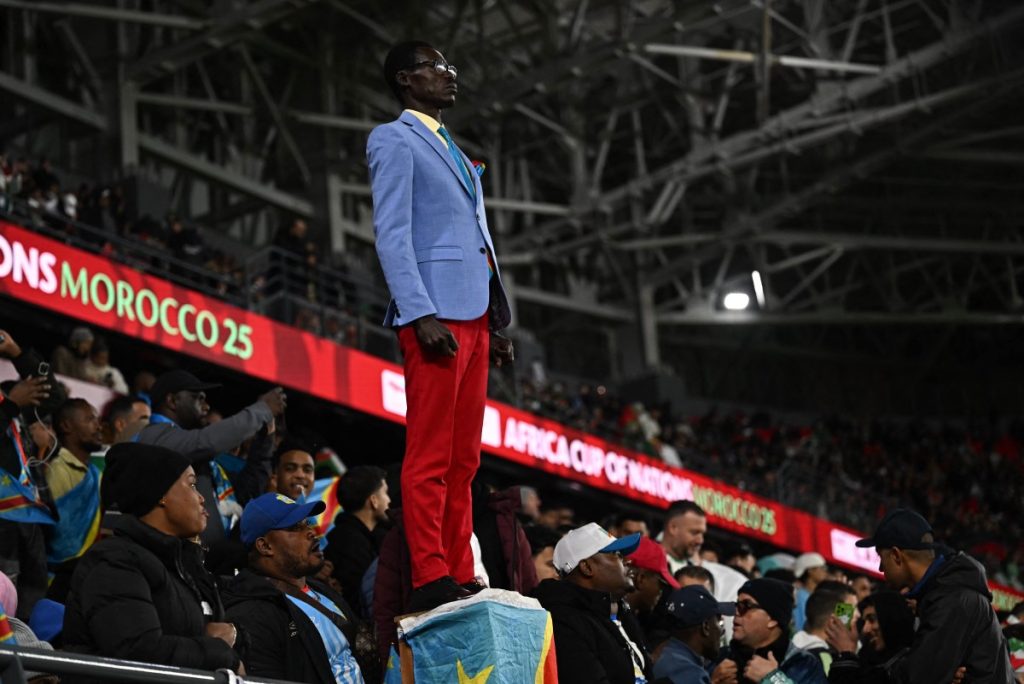
Despite DR Congo’s dramatic exit from the 2025 Africa Cup of Nations, one supporter has etched his name into AFCON folklore. Michel Kuka Mboladinga, widely known as the “human statue,” has emerged as one of the tournament’s most unforgettable figures, captivating fans, players, and media alike with a silent but deeply symbolic presence.
At matches in Rabat, Kuka stood completely motionless in the stands, eyes fixed skyward, right arm raised with an open palm. Dressed in striking colours, his stillness contrasted sharply with the noise and intensity of AFCON, turning him into a powerful visual symbol that quickly went viral across social media and global news platforms.

A Living Tribute to Patrice Lumumba
Kuka’s pose is a deliberate homage to Patrice Lumumba, DR Congo’s independence hero and the nation’s first prime minister. The stance mirrors a well-known statue of Lumumba in Kinshasa, honouring a leader whose life and legacy remain central to Congolese identity.
Lumumba briefly led the country after independence in 1960 before being assassinated a year later in a plot involving Katangan separatists and Belgian mercenaries. His death, and the disappearance of his remains later revealed to include a tooth kept in Belgium stands as one of the darkest chapters in Congo–Belgium relations.
For many Congolese supporters, Kuka’s silent tribute brought Lumumba’s memory to the global stage.
“He is our brother,” said Laetitia Malula, a 30-year-old fan in Casablanca. “By imitating Lumumba, our hero, he reminds the world of who we are. That’s why we chant his name.”
From Super Fan to Global Symbol
Kuka’s fame grew rapidly during the tournament. Ahead of DR Congo’s round-of-16 clash with Algeria, he was joined by hundreds of Congolese supporters in Rabat, many of whom travelled to Morocco as part of a government-backed delegation.
Although the Leopards were narrowly eliminated, losing 1–0 to a late extra-time goal, Kuka’s presence overshadowed the result, drawing admiration far beyond the pitch.
Known to have first adopted the pose years ago during matches of AS Vita Club, one of DR Congo’s biggest football teams, Kuka has long used football as a stage for expression. However, the scale of attention at AFCON prompted him to retreat from direct media engagement.
A Message of Peace Beyond Football
According to Jered Bitobo, communications head of Kuka’s supporters group, the gesture goes beyond history and football.
“The open palm is a sign of peace,” Bitobo explained. “He is sending a strong message, locally and internationally. Our country needs peace.”
DR Congo’s AFCON campaign unfolded against the backdrop of ongoing conflict in the eastern region of the country, where violence has intensified since 2021 due to the resurgence of the Rwandan-backed M23 armed group. For many fans, Kuka’s silence spoke directly to that reality.
While goals and trophies define tournaments, AFCON 2025 will also be remembered for moments that transcend sport. Michel Kuka Mboladinga’s unwavering stillness rooted in history, identity, and a plea for peace has ensured that even in defeat, DR Congo left an indelible mark on the competition.
Long after the final whistle, the image of AFCON’s “human statue” will remain one of the tournament’s most powerful and enduring symbols.
Get real time update about this post category directly on your device, subscribe now.
Discover more from The Trenet
Subscribe to get the latest posts sent to your email.

