
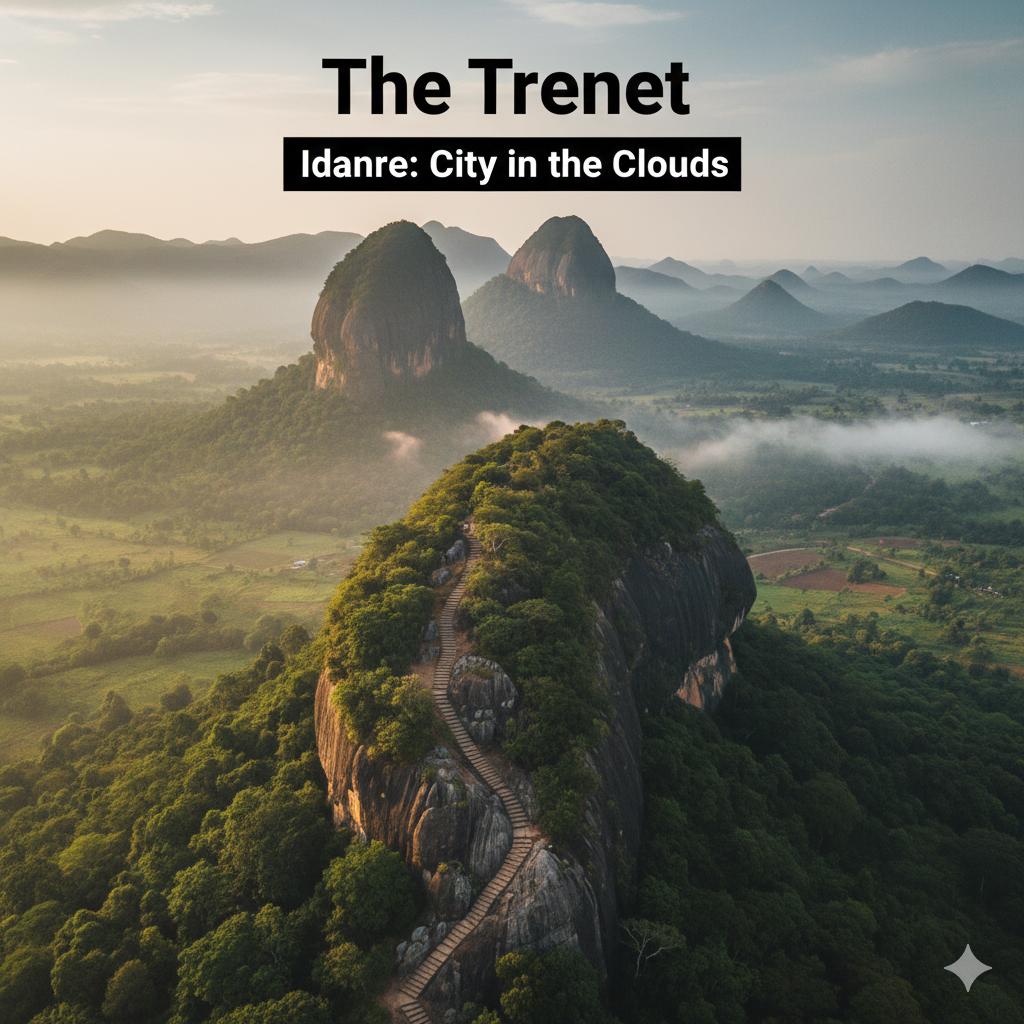

In the heart of Ondo State lies a landscape so magnificent it feels as though the gods themselves carved it. Idanre Hill (Oke Idanre) is not just a geological wonder; it is a 3,000-foot-high fortress of history, a UNESCO tentative site, and a living testament to the endurance of the Yoruba people.Yoruba History and Settlements
For nearly a thousand years, the entire population of Idanre lived atop these massive boulders. It wasn’t until 1923 that they moved to the plains below, leaving behind a “silent city” in the clouds that remains largely undisturbed to this day.
The Ascent: A Journey Through Time
To reach the pinnacle of Idanre’s history, one must conquer 680 steps. As you climb, the air cools and the modern world fades, replaced by spectacular valleys interspersed with towering inselbergs.The Mystery and Magic of Idanre Hills
What makes Idanre truly mysterious?
- Ese Agboogun (The Magical Footprint): Near the peak of Aghagha Hill lies a permanent human footprint in the rock. Legend says it belongs to Agboogun, the first ruler of Idanre. It is said that any visitor whose foot fits perfectly into the print is a true son of the soil or a person of pure heart.
+1 - The Unreadable Handwriting: On the hills, there are ancient, mysterious inscriptions on the rock faces that look like calligraphy. To this day, scholars and researchers are still trying to decode these “cryptic scripts” left by ancestors.
- Omi Apaara (Thunder Water): A mysterious stream where the water is believed to have “thunderous” properties, historically used for warriors preparing for battle.

A Living Museum of Yoruba Heritage
Unlike many abandoned historical sites, Idanre Hill has retained its structural soul. Visitors can still walk through the Owa’s Palace, see the Old Court, and stand in the 19th-century missionary school, the first in the area.Oke Idanre (Idanre Hill) Tentative List
The hills are also a biodiversity hotspot. From the Hyrax (a unique tailless animal) to the rare monkeys of the Orosun hills, the ecosystem is as rich as the culture. The hills even host an annual Festival of Bats, celebrating the massive colonies of bats that have called these caves home for centuries.Tourism in the Sunshine State
Cultural Influence: From Dala to Nobel Prizes
Idanre Hill holds a similar significance to Dala Hill in Kano. Just as Dala was the nucleus of the ancient Kano city, Oke Idanre was the cradle of the Idanre people.
Its beauty is so profound that it inspired Africa’s first Nobel Laureate, Professor Wole Soyinka, to write his longest poem, “Idanre and Other Poems.” Today, the hills serve as a prime location for filmmakers, field researchers, and spiritual seekers.

A Legacy of Resilience
The story of the Idanre people, moving from the rugged hills to the plains, mirrors the journey of many Nigerian groups who adapted to their environment to survive. As we saw in our feature on the Koma People of the Alantika Mountains, the hill-dwelling culture of Nigeria is a deep-rooted strategy for independence and cultural preservation.
Get real time update about this post category directly on your device, subscribe now.
Discover more from The Trenet
Subscribe to get the latest posts sent to your email.

